From 5.7k to 56k RPS: Making Rust Say Yes to a Million Requests
This is a story about a Rust web service that accepts messages over HTTP and persists them. Simple, right? That's what I thought too. But somewhere between "just write it to Postgres" and serving 1.12 million requests in a 20-second load test, I learned a lot about where throughput actually goes to die.
The project is my Rust implementation of node-1m-rps — rebuilt with Axum + Redis Streams + SQLx (PostgreSQL), and benchmarked every step of the way with autocannon. The code is on GitHub if you want to follow along.
The Setup
The requirements were honest and small:
POSTa message (from,to,message)- Persist it to PostgreSQL
- Return a
201with the created message
The stack:
- Web framework:
axum 0.8 - Runtime:
tokio(multi-thread, work-stealing) - Database:
sqlx 0.9+ PostgreSQL 17 - Message broker:
redis 1.6(Streams + consumer groups) - Validation / errors:
validator 0.20,thiserror 2.0
A layered structure, because future-me deserves clean code too:
Request -> routes -> handler -> service -> repository -> ???
                            \- entity (domain) / dto (transport)
That ??? at the end of the pipeline is where this whole story lives.
Act 1: The Naive Version — Write Straight to Postgres
First version: HTTP request comes in, we validate it, run an INSERT, return. One database, zero moving parts.
pub async fn create_message_direct(
  &self,
  payload: MessageCreateDto,
) -> Result<MessageReadDto, ApiError> {
  let message = Message {
      id: Uuid::new_v4(),
      from: payload.from_,
      to: payload.to,
      message: payload.message,
      created_at: OffsetDateTime::now_utc(),
  };

  sqlx::query(
      r#"INSERT INTO messages (id, "from", "to", message, created_at)
         VALUES ($1, $2, $3, $4, $5)"#,
  )
  .bind(message.id)
  .bind(&message.from)
  .bind(&message.to)
  .bind(&message.message)
  .bind(message.created_at)
  .execute(&self.pg_pool)
  .await?;

  Ok(MessageReadDto::from(message))
}
Clean. Readable. Correct. And — spoiler — 10x slower than what I ended up with.
Enter autocannon
I fired up autocannon to see what this thing could actually do:
autocannon -m POST \
--connections 100 --duration 20 --pipelining 20 \
-H "Content-Type: application/json" \
-b '{"from":"alice","to":"bob","message":"Hello from Postman!"}' \
"http://127.0.0.1:3000/message"
100 connections, 20x pipelining, 20 seconds. Here's what came back:
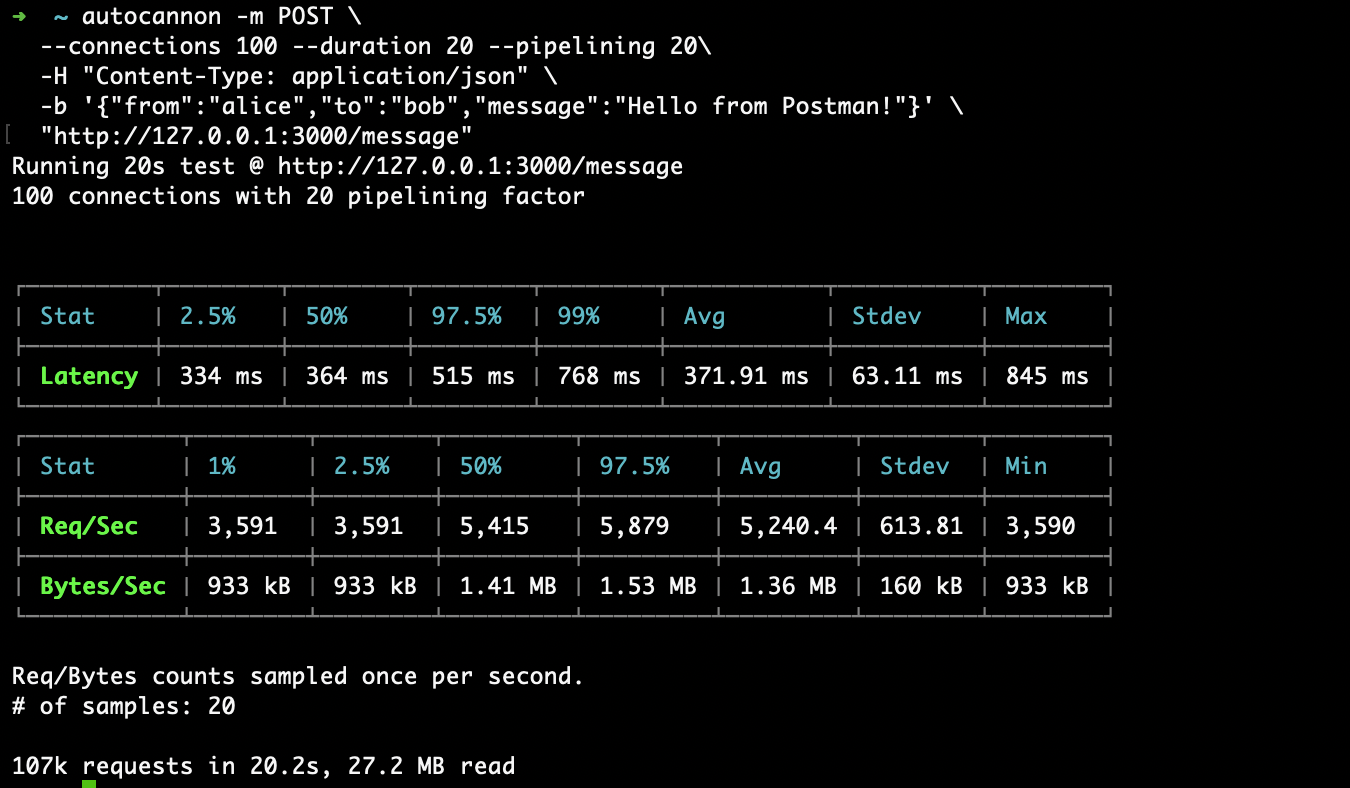
- Avg latency: 345.77 ms (p50: 342 ms)
- p99 latency: 470 ms
- Avg throughput: ~5,727 req/sec
- Total requests: 117k in 20s
~5.7k RPS and a third of a second of latency per request. For a Rust server on a modern machine, that's... suspicious. Rust isn't slow, so something else was.
Act 2: The CPU Graph That Refused to Lie
I opened the core utilization graph while the test was running, and this is what I saw:
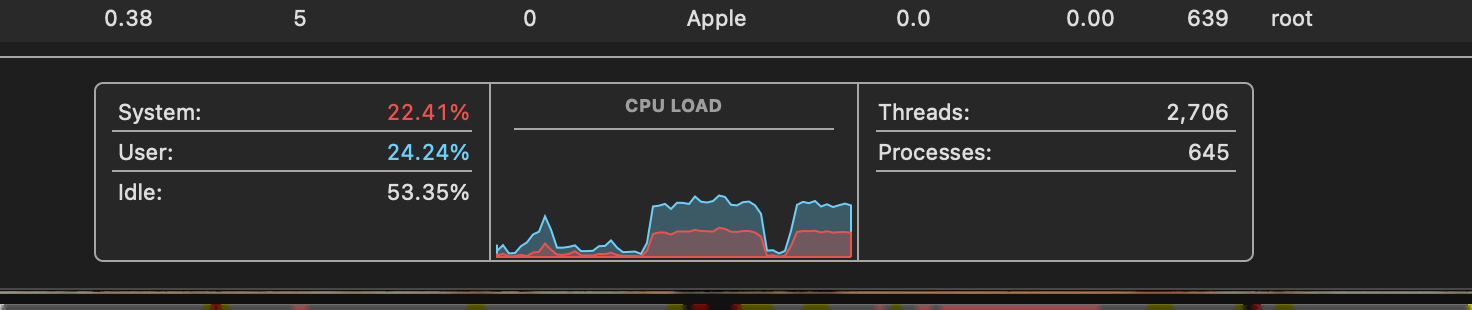
50–55% idle. On every core. Under full load.
Half my CPU was sitting there doing absolutely nothing while my server was allegedly getting hammered.
And that was the clue. Tokio's multi-thread runtime already spreads work across one worker thread per logical core — the machinery was there. The problem was what those threads were doing: each request handler awaits a Postgres INSERT. While it waits on the database (disk flush, WAL, connection pool checkout, network round-trip), the request is parked. Work is available — 100 connections × 20 pipelined requests deep — but every single one of them funnels through synchronous DB writes, one at a time, per request.
The server wasn't CPU-bound. It was database-round-trip-bound. Postgres is a fantastic database, but it is not an in-memory buffer, and asking it to durably store 100+ individual rows per second per connection turns your fancy async runtime into a very expensive waiting room.
So the question became: how do I keep the CPU fed and stop making every request pay the disk-flush tax?
Act 3: Put Redis in the Hot Path
The insight: an HTTP 201 doesn't require the row to be in Postgres yet. It requires the message to be safely accepted. So I split the write path:
- Hot path: HTTP handler →
XADDto a Redis Stream → return201. Redis is in-memory and append-only; this is microseconds, not milliseconds. - Cold path: a background worker consumes the stream and batch-inserts into Postgres at its own pace.
HTTP Request
  |
  v
+--------+     XADD (Redis Stream)     +------------------+
| Server | ----------------------------> | Redis: messages  |
|        |                               | :stream          |
+--------+                               +------------------+
                                             |
                                             | XREADGROUP
                                             v
                                       +------------------+
                                       | Sync Worker      |
                                       | (batch insert)   |
                                       +------------------+
                                             |
                                             | INSERT ... 500 rows
                                             v
                                       +------------------+
                                       | PostgreSQL       |
                                       +------------------+
The hot path: one XADD, done
The repository layer changed from "talk to Postgres" to "append to a stream":
async fn create(&self, payload: MessageCreateDto) -> Result<Message, DbError> {
  let message = Message {
      id: Uuid::new_v4(),
      from: payload.from_,
      to: payload.to,
      message: payload.message,
      created_at: OffsetDateTime::now_utc(),
  };

  let data = serde_json::to_string(&message)
      .map_err(|e| DbError::SomethingWentWrong(e.to_string()))?;

  let mut conn = self.db_conn.get_connection();

  let _ = conn
      .xgroup_create_mkstream(Message::STREAM, Message::GROUP, "$")
      .await;

  let _: Option<String> = conn
      .xadd(Message::STREAM, "*", &[("data", data.as_str())])
      .await
      .map_err(|e| DbError::SomethingWentWrong(e.to_string()))?;

  Ok(message)
}
That xgroup_create_mkstream call on every write looks odd, but it's idempotent — it just guarantees the consumer group exists before the worker ever reads. Errors are ignored on purpose.
I kept the old direct-write endpoint at POST /message and exposed the new path as POST /message-fast — same validation, same response shape, so I could A/B them against each other:
pub fn route() -> Router<MessageState> {
  Router::new()
      .route("/message-fast", post(message_fast_handler))
      .route("/message", post(message_direct_handler))
}
The cold path: batch like you mean it
The sync worker is a separate binary that loops forever:
XREADGROUPwithcount(500)andblock(300ms)— pull up to 500 messages per read- one bulk
INSERTfor the whole batch viasqlx::QueryBuilder::push_values XACKonly after a successful insert
async fn insert_batch(&self, entries: &[StreamEntry]) -> Result<(), sqlx::Error> {
  let mut qb =
      QueryBuilder::new(r#"INSERT INTO messages (id, "from", "to", message, created_at) "#);

  qb.push_values(entries, |mut b, entry| {
      b.push_bind(entry.message.id)
          .push_bind(&entry.message.from)
          .push_bind(&entry.message.to)
          .push_bind(&entry.message.message)
          .push_bind(entry.message.created_at);
  });

  qb.push(" ON CONFLICT (id) DO NOTHING");

  qb.build().execute(&self.db_pool).await?;
  Ok(())
}
Instead of 500 round-trips, Postgres now handles 500 rows in one statement. The database gets durable writes at a pace it likes, and the message stays safe in Redis the entire time — if the batch insert fails, the worker doesn't ACK, and Redis simply redelivers those entries on the next read. Poison messages (bad JSON, missing fields) get ACKed immediately so one malformed entry can't clog the stream.
And because every message carries a server-generated UUID plus ON CONFLICT (id) DO NOTHING, a crash-between-insert-and-ACK scenario — the classic at-least-once duplication — is silently absorbed. At-least-once delivery becomes effectively exactly-once persistence.
Act 4: The Numbers
Same machine. Same autocannon flags. New endpoint:
autocannon -m POST \
--connections 100 --duration 20 --pipelining 20 \
-H "Content-Type: application/json" \
-b '{"from":"alice","to":"bob","message":"Hello from Postman!"}' \
"http://127.0.0.1:3000/message-fast"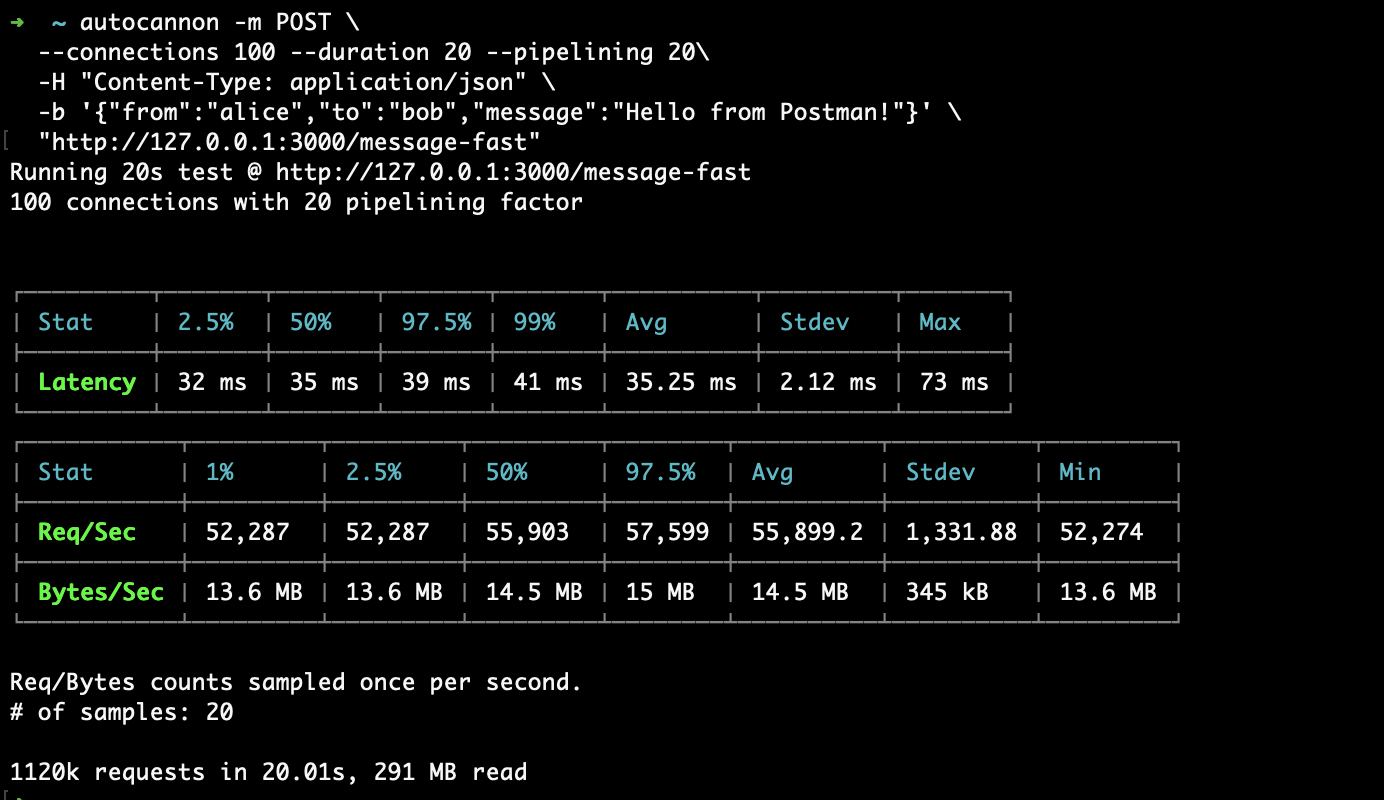
| Metric | Before (direct PG) | After (Redis stream) | Δ |
|---|---|---|---|
| Avg latency | 345.77 ms | 35.25 ms | ~10x |
| p99 latency | 470 ms | 41 ms | ~11x |
| Avg throughput | ~5,727 req/sec | ~55,899 req/sec | ~10x |
| Total requests | 117k in 20s | 1.12M in 20s | ~10x |
| Data transferred | 29.8 MB | 291 MB | ~10x |
And the part I was most curious about — the CPU graph:

Idle dropped from 50–55% to 6–7%. The cores that were previously napping while handlers waited on Postgres are now actually processing requests. Same runtime, same thread count, same machine — the only change was removing the disk round-trip from the request path. The throughput gain didn't come from working harder; it came from stopping the CPU from waiting.
Why no PM2-style clustering?
The original Node project needs PM2 with instances: "max" and exec_mode: "cluster" — because Node is single-threaded per process, and forking one process per core is the only way it can use more than one core.
Rust needs none of that here. #[tokio::main] with features = ["full"] gives you a multi-thread work-stealing scheduler with one worker thread per logical core, inside a single process. Connections become tokio tasks and get spread across all workers automatically.
Node (node-1m-rps) | Rust (this project) | |
|---|---|---|
| Threads per process | 1 (single event loop) | N (= logical CPU cores) |
| Uses all cores | only via PM2 instances: "max" | automatic via tokio rt-multi-thread |
| Clustering needed? | yes (process-per-core) | no (thread-per-core in one process) |
Honest caveat: with a single TcpListener, connection acceptance is serialized on one task even though request handling is parallel. With keep-alive + pipelining on a modest number of connections, that's a non-issue. If it ever becomes the ceiling, SO_REUSEPORT + multiple processes is the equivalent fix — PM2 just does that trick by default.
What I Took Away From This
- Measure before you optimize. I assumed the bottleneck was "Rust + JSON parsing" or something glamorous. The CPU graph said: nope, you're I/O-bound, half the machine is idle.
- "Slow" is often just "waiting." The 10x didn't come from making anything faster — it came from taking a disk-flip out of the request's critical path.
- Buffering writes isn't cheating durability. Redis Streams + consumer groups + ACK-after-insert + idempotent batch inserts means nothing is lost, and a crash is a redelivery, not data loss.
- Boring architecture, fast numbers. The winning design is a textbook decoupled write path — it just took me a load test and an idle CPU graph to actually respect it.
What's Next
The natural follow-ups, in the order I'll probably attack them:
- Dead-letter stream — the
messages:deadconstant already exists; the worker just doesn't publish to it yet SO_REUSEPORT+ multiple acceptors if the single-acceptor ceiling ever shows up in a profile- Tuning
XREADGROUPbatch size / block time against different Postgres configs - Running the whole thing on real hardware instead of my laptop, where "1M rps" stops being "1M requests per 20-second run" and starts being per second
If you want to run it yourself — Postgres + Redis via Docker, migrations, both endpoints, the benchmark commands — everything is in the repo README.
Thanks for reading — now go check your CPU idle graph.